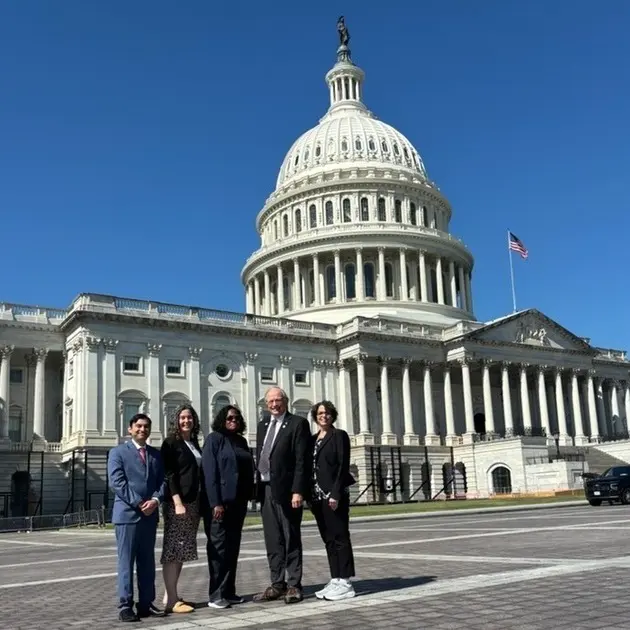
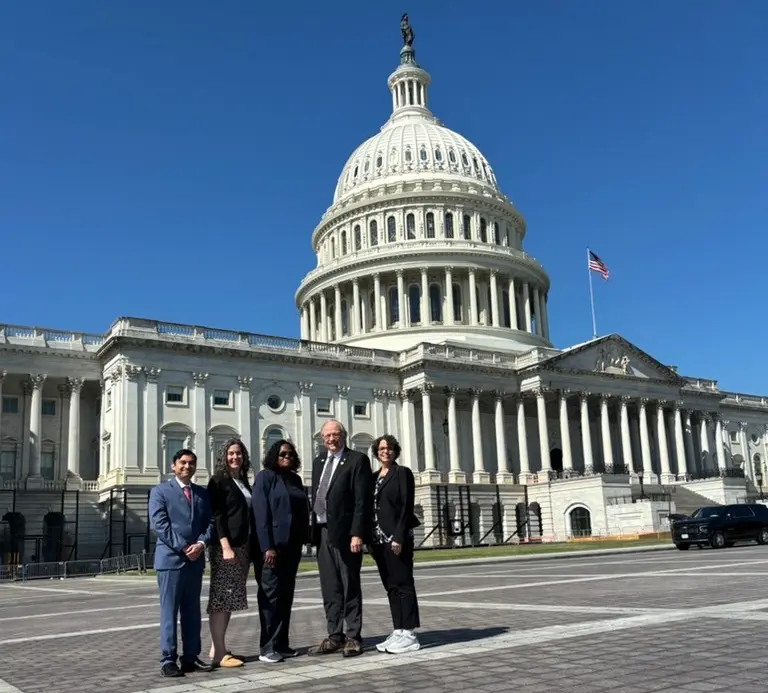
Members of the College and ACAAI’s Advocacy Council recently spent three days on Capitol Hill meeting with members or legislative assistants in more than 25 Congressional offices to discuss a range of policy issues that would benefit allergists and our patients. This year’s “Strike Force 2.0” builds upon the momentum from our annual advocacy Strike Force that occurs every May, in conjunction with the Allergy and Asthma Network’s World Asthma Day.
Participating in this year’s Strike Force 2.0 were ACAAI President Dr. Cherie Y. Zachary, Vice President Dr. Maureen M. Petersen, Executive Director of Advocacy and Government Affairs Dr. J. Allen Meadows, Treasurer Dr. Melinda Rathkopf, and Vice Speaker of the ACAAI House of Delegates Dr. Vivek Rao. The participants were supported by ACAAI’s legislative government relations consultants Matt Reiter and Jasmine Garner.
This is a relatively slow period for legislative activity, as members of Congress are spending much of their time away from the Capitol in their home districts ahead of the November midterm elections. However, the “lame-duck” session that follows is expected to be particularly busy, as Congress works to advance as much legislation as possible before the session ends at the close of the year.
Strike Force 2.0 was well timed to remind Congress of our legislative priorities ahead of this critical post-election sprint to the finish line.
These issues included three main advocacy topics:
1. Building support for the Allergy and Asthma Patient Protection (AAPP) Act. This bill will be introduced by Rep. Bob Onder, MD, FACAAI, (R-MO-3), the only allergist in Congress, in the next few weeks. The bill is a partnership between the College’s Advocacy Council and Congressman Onder to address many of the commercial payer issues that are specific to allergists.
One of those issues is urging CMS to follow the CPT definition of a dose of allergy extract for billing under code 95165. Medicare currently defines a billable unit as 1 cc of extract, rather than following the CPT definition based on the amount administered in a single injection. The College and the Advocacy Council sought congressional support for aligning Medicare’s billing policy with CPT to better reflect how allergists prepare and administer immunotherapy and ensure fair payment for this essential service.
2. Medicare reimbursement reforms include preventing Medicare payment cuts to physicians in 2027 and sustainable, inflation-based annual payment adjustments to Medicare payments to physicians.
3. Encouraging the FAA to require FDA-approved epinephrine for self-administration (or administration by non-medical professionals) on all commercial flights. The College and its Advocacy Council helped lead a successful 2024 legislative effort requiring the FAA to assess whether the required contents of airplane emergency medical kits (EMKs) are adequate to treat anaphylaxis and other medical conditions, and to propose regulatory updates based on that assessment. Although EMKs currently contain epinephrine in ampules for subcutaneous administration, this formulation is not a practical treatment for anaphylaxis during an inflight emergency. Unfortunately, the FAA declined to propose a requirement that EMKs include a more user-friendly form of epinephrine, instead leaving individual carriers to determine how to stock their EMKs to address anaphylaxis.
Strike Force 2.0 helped align with our congressional allies on this issue to support a congressional letter to the FAA advocating for a clear requirement for airplanes to include FDA-approved epinephrine delivery devices for self-administration in EMKs. Our advocacy played an important role in getting 20 House and Senate congressional members to sign the letter.
Our meetings focused on strengthening our already strong bipartisan relationships with champions for allergy and physician issues in both the House and Senate. These include key leaders of the Congressional Allergy and Asthma Caucus, Congressional Food Allergy Research Caucus, GOP Doctors “Doc” Caucus, the Democratic Doctors Caucus and other members that have a special interest in allergy issues.
The meetings also included representatives and senators who chair key committees and subcommittees with jurisdiction over our policy priorities, such as Rep. Morgan Griffith (R-VA-9), who chairs the House Energy and Commerce Committee’s Health Subcommittee. Rep. Griffith has spoken openly about his experience of living with Alpha-gal syndrome. While the House of Representatives was not in session during this visit, the College met Rep. Griffith during our Capitol Hill visits earlier this year where we had the opportunity to thank him for his leadership on allergy issues and to encourage him to add more allergy leaders such as Rep. Onder to the E&C Health Subcommittee.
The fall Strike Force is just one example of how the College and its Advocacy Council are fighting for allergists and patients. We will continue to push for our policy priorities through the end of the year and beyond. We encourage members to read the weekly Advocacy Insider articles to stay up to date on our advocacy work.
The Advocacy Council – ADVOCATING FOR ALLERGISTS AND THEIR PATIENTS.