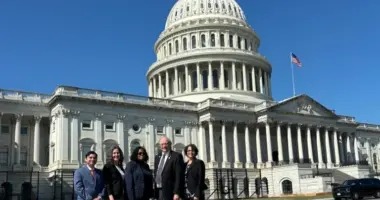
This week, a group of allergists will meet in Washington D.C. for the College’s 2026 Advocacy “Strike Force 2.0” on Capitol Hill. The College recognizes that in-person visits are powerful and often are needed more than once a year. This visit to our nation’s Capital is an opportunity for the College to continue educating Congress about our advocacy priorities and strengthen relationships with legislators who can help make these priorities a reality.
Participating in this year’s Strike Force 2.0 are ACAAI President Dr. Cherie Y. Zachary, Vice President Dr. Maureen M. Petersen, Executive Director of Advocacy and Government Affairs Dr. J. Allen Meadows, Treasurer Dr. Melinda Rathkopf, and Vice Speaker of the ACAAI House of Delegates Dr. Vivek Rao. The participants will be supported by ACAAI’s legislative government relations consultants Matt Reiter and Jasmine Garner.
The group’s schedule features more than 20 meetings with congressional offices and caucuses with jurisdiction over our priorities. The Strike Force focuses on the day-to-day issues that impact allergists’ ability to practice medicine and provide care for patients. Our fall advocacy topics include improving Medicare payments to physicians by applying an annual inflationary update to physician Medicare payments and the absence of the Federal Aviation Administration’s enforcement for including life-saving epinephrine auto-injectors in commercial airline Emergency Medical Kits. There is optimism that Congress will return to these issues after the November mid-term elections.
In addition to those issues, the group will meet with many congressional offices about the forthcoming Allergy & Asthma Patient Protection (AAPP) Act championed by ACAAI. The AAPP Act will address insurer coverage policies that restrict patient access to allergen immunotherapy and clinically indicated allergy and asthma testing. The legislation will require insurance coverage consistent with established clinical standards and prohibit insurance practices such as denying immunotherapy buildup, imposing arbitrary testing or treatment limits, and reducing reimbursement based on diluent use. These practices can create significant administrative and financial burdens for allergists through increased claims denials, documentation requirements, and appeals processes, while limiting access to clinically proven treatments for patients.
While the AAPP Act does not yet have an official bill number, the Strike Force identified many congressional allies who are willing to support the bill ahead of its introduction. We will continue to keep ACAAI members updated on how they can support the AAPP Act in the future.
The biggest congressional champion for this issue is AAPP Act sponsor, Rep. Bob Onder, MD, an allergist and ACAAI member. Having an allergist in Congress fighting for our specialty at this critical time is an enormous advantage. Our group has a private breakfast scheduled with Rep. Onder to discuss the AAPP Act and other important issues for our specialty.
The College’ advocacy work does not stop after the Strike Force participants fly home. Our advocacy team will be hard at work following up on our action items from these important meetings. We encourage members to read the weekly Advocacy Insider articles to stay up to date on our advocacy work.
The Advocacy Council – ADVOCATING FOR ALLERGISTS AND THEIR PATIENTS.