
The Raft Debates (2004-2016)
The first College raft debate was held at the 2004 ACAAI Annual Scientific Meeting in Boston. For many years, the College had featured Point-Counterpoint debates on controversial topics. Sometimes the topics weren’t all that controversial, and sometimes the debaters even ended up affirming each other’s viewpoints. All too often a speaker could make some good points in a few slides, and then fill the rest of the time with perhaps less-interesting material.
In planning the 2004 Annual Meeting, President-elect and Program Chair Myron Zitt had identified the clinically relevant question of what is the most important cell in the pathogenesis of asthma. The topic didn’t seem appropriate for a normal plenary session or a point-counterpoint session, since there were several well-reasoned viewpoints.
At the same time, Vice President William Dolen had participated in (and won) the first-ever specialty-choice ‘raft debate’ at the Medical College of Georgia. This had been patterned from the long-standing raft debates (dating from the mid-1900s) at William & Mary, described there as a “delicate balance of comedy and lecture.” That format seemed perfect for an unusual plenary session at the College.
It came together as topics were chosen: 1) eosinophils, 2) mast cells and basophils, 3) lymphocytes, 4) neutrophils, 5) epithelial cells, and 6) smooth muscle. However, the session only had a 2-hour time slot, so each speaker would be giving a very short talk in return for a full honorarium and other expenses. We therefore waited until most speakers for the rest of the meeting had been confirmed, and then from that list chose speakers for the debate itself. Each had only a few minutes for the presentation, and another few minutes for rebuttal, and the moderators very strictly enforced the time limits, being willing (if necessary) to escort a speaker away from the podium. The presentation order was randomly chosen immediately before the session.
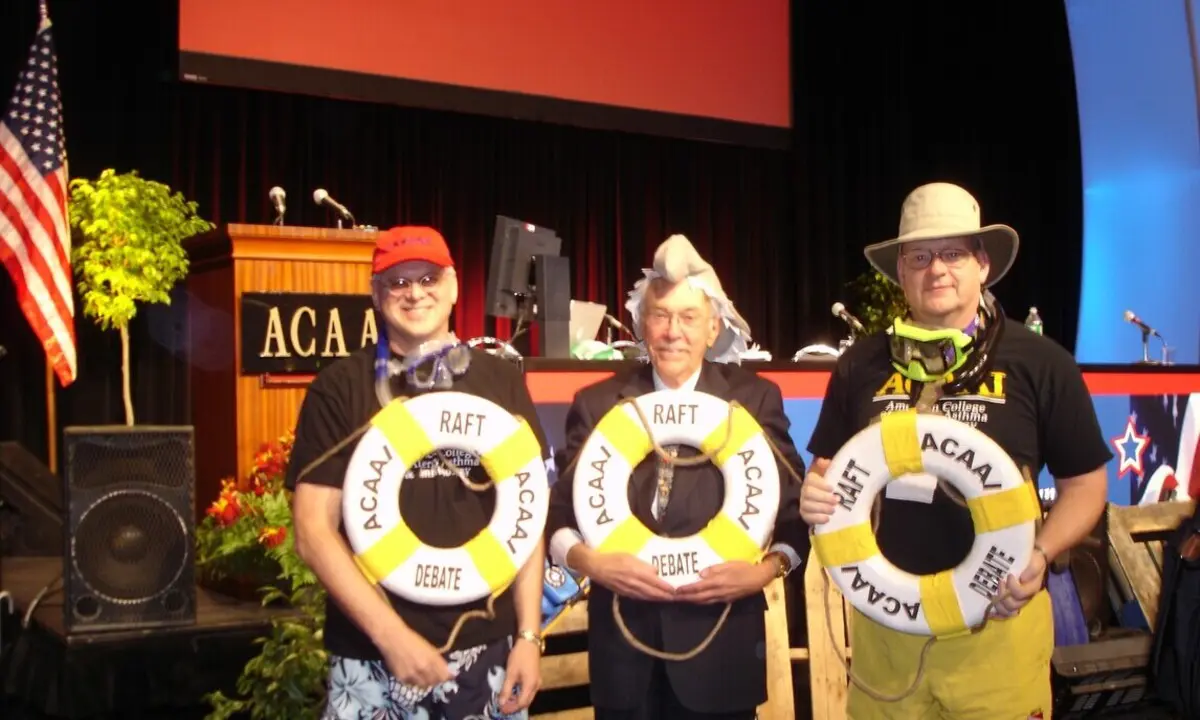
The premise was simple. College staff member Mary Lou Callaghan innovatively decorated the large lecture hall with a nautical theme. The debaters were cast adrift on a raft at sea, surrounded by hungry sharks (the audience, of course), and moderators Drs. Bill Dolen and Bill McCann wore College t-shirts and swimsuits. In the fine tradition of the William & Mary raft debates, the moderators assumed the role of Devil’s Advocate – interrupting and otherwise harassing speakers during and after their presentation, often asking questions that had nothing to do with their presentations or even falling asleep and snoring loudly. The audiovisual team played music from the film “Jaws” and speakers were introduced with photos of large sharks taken by Dr. Dolen. At the end of the debate, the volume of audience applause and cheering determined who would leave the raft, and in what order, until only one speaker was left in the raft. The moderators awarded the winner with a Jimmy Buffet shark hat, procured by Ms. Callaghan.
The debate format made for some raucous plenary sessions that over the years were generally very well-received due to the mixture of out-of-bounds comedy and concise clinically-relevant lectures. The competition between speakers was fierce. They always spoke passionately about their assigned topic, and very passionately about the viewpoints of the other speakers. At times there was even salty language. These were certainly the most concise and to-the-point lectures ever given at a College meeting. The raft debates went on for a 13-year course, covering various topics in the realms of asthma, atopic dermatitis, atopy, urticaria, anaphylaxis, ocular allergy, eosinophilic esophagitis, and food allergy.
The Great Asthma Raft Debate 2004
Boston, MA
Moderators: William K. Dolen, MD and William A. McCann, MD
Eosinophils
Larry Borish, MD
Mast cells/Basophils
Lawrence B. Schwartz, MD
Lymphocytes
Stephen R. Durham, MD
Neutrophils
William W. Busse, MD
Epithelial cells – Winner*
Stephen T. Holgate, MD
Smooth Muscle
D. Betty Lew, MD
* denotes winner
The debate over which one of six cells keeps asthma afloat came to a rest during the ACAAI Annual Meeting. Thanks to the Asthma Raft Debate, participants were swayed to vote wholeheartedly for epithelial cells as the sole survivor.
With their tongues firmly planted in their cheeks, six experts argued their cases for eosinophils, mast cells/basophils, lymphocytes, neutrophils, smooth muscle and epithelial cells….Stephen T. Holgate, MD, School of Medicine, University of Southampton, England, remained on the surface as the sole survivor.
“The inescapable conclusion is that asthma is an epithelial disease. The genetic predisposition for asthma lies in the epithelium’s aberrant response to the inhaled environment,” said Dr. Holgate, who noted that this is why corticosteroids fail to alter the natural history of asthma.
According to Dr. Holgate, as in other chronic wound situations, an altered immune response and inflammation are secondary to a breakdown in the epithelial defense. New therapies for asthma might involve agents that protect the epithelium against inhaled insults, such as from allergens, pollutants and microorganisms, and accelerate the wound repaid, said Dr. Holgate, who pointed to recent evidence of hrEGF dramatically reversing the remodeling and ulcerative changes in severe ulcerative colitis.
“I don’t in any way argue that inflammation isn’t important in asthma. Of course it’s important, and none of us would deny that, but is it primary? I believe it is not. I believe that the origins of asthma sit in the epithelium that’s responding abnormally to the environment,” he said.
He believes that a triggering set of pathways of altered communication exist between the overlying epithelium and the underlying mesenchymal. This communication results in the release in a variety of substances, which start to recruit and hold the inflammatory response in the airways, and those inflammatory response then feed on this abnormal trophic unit, he added.
“This is the reason why we’ve called it a trophic unit – because this is a disease that resides structurally within the conducting airways,” said Dr. Holgate.
While he agrees that all of the cells play a role, he said, “The epithelium is key to the initiation of asthma because it is what reads the environment. All the things that follow are secondary,” he said.
Source: ACAAI Meeting News, Post Issue, December 2004, pp. 1, 7.
The Great Asthma Raft Debate 2005:
What’s the Best Way to Follow a Patient With Asthma?
Anaheim, CA
Moderators: William K. Dolen, MD and Bryan L. Martin, DO
Interval History
Anthony Montanaro, MD
Serial Peak Flow Measurements & Forced Expiratory Spirometry
William J. Calhoun, MD
Serial Total Eosinophil Count, Sputum Eosinophilia, Serum Eosinophil Cationic Protein
Phillip L. Lieberman, MD
Sequential PC20 Following Methacholine Challenge
Sheldon L. Spector, MD
Exhaled Breath Condensates (exhaled NO2, exhaled LTB4)*
Joseph D. Spahn, MD
* denotes winner
The Great Asthma Raft Debate 2006:
Controller Therapy for Asthma
Philadelphia, PA
Moderators: William K. Dolen, MD and Bryan L. Martin, DO
Long-Acting Beta Agonists*
Harold S. Nelson, MD
Immunotherapy
Ira Finegold, MD
Antileukotrienes
Donald Cockcroft, MD
Immunomodulation
Lanny Rosenwasser, MD
ASA Desensitization
David M. Lang, MD
* denotes winner
The Great Asthma Raft Debate 2007:
What Causes Asthma?
Dallas, TX
Moderators: William K. Dolen, MD and Bryan L. Martin, DO
Allergen Exposure
Dennis R. Ownby, MD
Genetics*
Lanny J. Rosenwasser, MD
Infections
Michael S. Blaiss, MD
Air Pollution & Chemicals
Richard W. Weber, MD
Lifestyle
Thomas A.E. Platts-Mills, MD
* denotes winner
The Great Asthma Raft Debate 2008:
Barriers to Care
Seattle, WA
Moderators: William K. Dolen, MD, and Bryan L. Martin, DO
Access to Care
Michael B. Foggs, MD
Patient Adherence*
Allan T. Luskin, MD
Distrust of Medical Profession
Richard Weber, MD
Delayed Asthma Diagnosis
Phillip Lieberman, MD
Cultural/Lifestyle
Michael S. Blaiss, MD
Genetic Discrepancies
Deborah A. Meyers, PhD
* denotes winner
The Great Asthma Raft Debate 2009:
Which is the Most Important Mechanism?
Miami Beach, FL
Moderators: William K. Dolen, MD, and David A. Kaufman, MD
Mast Cells and Eosinophils
Larry Borish, MD
Smooth Muscle and Epithelial Cells
James Martin, MD
Lymphocytes – Winner*
Thomas A.E. Platts-Mills, MD, PhD
Nervous System
William W. Busse, MD
* denotes winner
The Great Atopic Dermatitis Raft Debate 2010:
The Greatest Role in Pathophysiology of AD
Phoenix, AZ
Moderators: William K. Dolen, MD, and David R. Weldon, MD
Keratinocytes and Langerhan Cells*
Mark Boguniewicz, MD
T Cells
Donald Leung, MD
Mast Cells and Basophil
Lawrence B. Schwartz, MD, PhD
Eosinophils
Mitchell H. Grayson, MD
* denotes winner
See more Great Raft Debates (2011 – 2016)
