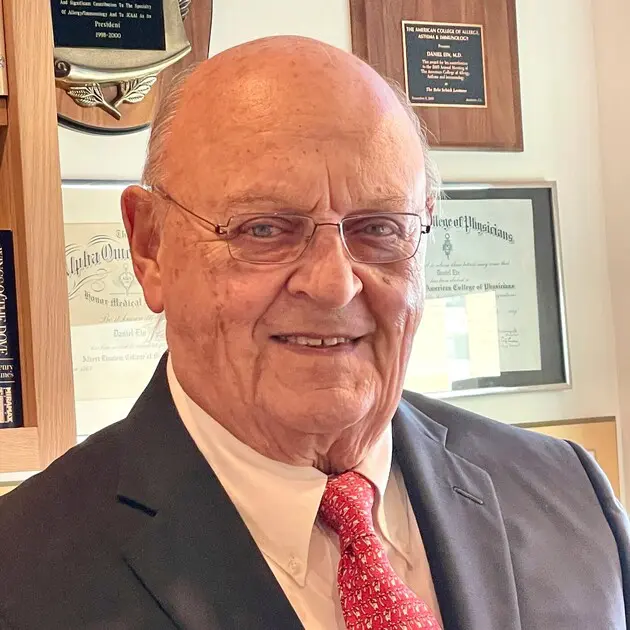
I am truly honored and humbled to be nominated for this prestigious award. To be included in the illustrious group of colleagues who have been nominated before me is one of the greatest honors of my life and, for that, I am grateful.
I was determined to become a physician from an early age. I majored in premed at Columbia University and received my medical degree from Albert Einstein College of Medicine, both in New York. I interned in medicine at Einstein and then served in the US Public Health Service at the National Cancer Institute of the NIH for six years. During this time, I was detailed to Massachusetts General Hospital where I did residency training in internal medicine. At NIH, I conducted research and published articles on immunoglobulin structure, amyloid (where we discovered the amino acid sequences of several forms of amyloid) and immune deficiency. At about this time, IgE and its role in allergy were discovered, and that led me to seek training in allergy at George Washington University and to allergy practice.
After 35 years of private practice, I became a full-time professor of medicine at George Washington University, where I am currently Clinical Professor Emeritus of Medicine. I took over the allergy division and developed a six-person practice that included teaching medical students and residents. We also helped train NIAID Fellows who came to our clinic for their major experience in clinical allergy. We engaged in clinical research that resulted in significant publications each year. In 2014, I formed the Coalition for Drug Allergy, a multicenter group of drug allergy experts from all over the US, dedicated to research in diagnostic and mechanistic studies of drug allergies. This continues to the present as the Diagnostic Approaches to Cephalosporin Allergy Testing (DACAT).
I became an ACAAI Fellow in 1996 and became president of the Joint Council of Allergy, Asthma and Immunology (JCAAI) that year.
It was while I was president of JCAAI that I got to know the College intimately and was struck by its dedication to the practice of allergy and our patients, based on rigorous science. The physicians in the College were warm and welcoming, and I was drawn to becoming more involved with the organization. I had experience with organizations, having served as president of the Medical Society of the District of Columbia and as a delegate to the AMA House of Delegates. I already knew Ira Finegold, my friend and mentor. I got to learn a great deal from Don Aaronson, whose lessons stay with me to the present. I served on the ACAAI Board of Regents from 2000 – 2003 and ultimately as president in 2006-2007, one of the best years of my professional life.
The outstanding new project of that year was the initiation of a public relations program to increase public awareness about allergy and allergists. Another was the introduction of omalizumab, which required negotiation with FDA. The FDA wanted to impose a two hour wait in the doctor’s office after each injection. We were able to convince the FDA that this was not necessary. We addressed workforce issues, which resulted in a white paper on GME and set out a vision for the future of allergy, including increasing the scope of practice to encompass the changes being brought to allergy at the time – the introduction of biologics, the increase in interest in mast cell disease, our role in diagnosis and treatment of drug allergy and vaccine use and side effects.
I have served on 24 different College committees. I have been chair or vice chair of 13 of them, including the Archives Committee, Joint Task Force on Health Care Reform, Executive Committee, Nominating Committee, and the Ad Hoc Committee to advise ACP/ASIM.
I also represented ACAAI at the American College of Physicians on the Council on Specialty Societies and the Subspecialty Advisory Group on Socioeconomic Affairs.
I have been honored to receive the following awards from the College: Distinguished Fellow (2013), Distinguished Service (2010) and the Bela Schick lecture (2005). Other honors have included Alpha Omega Alpha, Best Doctors in America (1997-2019), Castle-Connolly Best Doctors (2009-2021) and Washingtonian Best Doctors every year since founding until I retired in 2022. The Medical Society of DC awarded me their Distinguished Service Award in 2008. In 2020, I got the Walter Lester Henry Jr Memorial Award for a Lifetime of Excellent Teaching, an award which meant a great deal because of my deep commitment to educating future generations of physicians.
Again, I am profoundly grateful to the College for this nomination. Membership in the College, for me, has been and continues to be, a much-cherished privilege and one that has brought me both professional and personal opportunities that have enriched my life and have provided many happy memories.